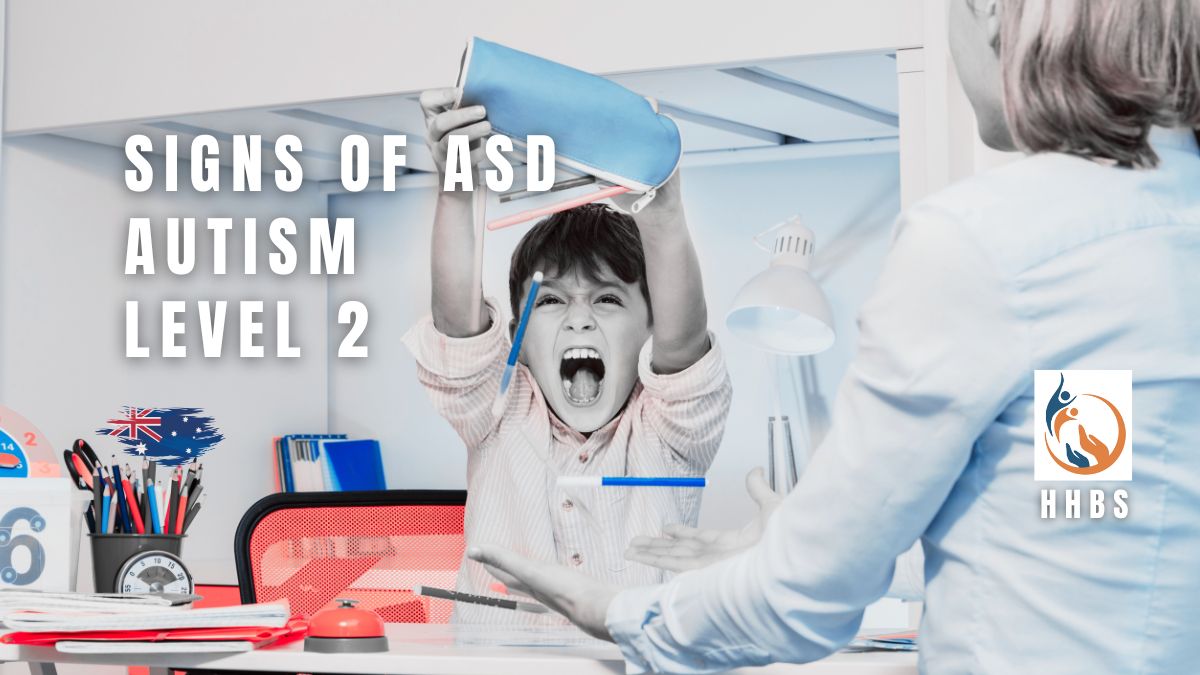
Early signs of Level 2 autism usually show up between 12 months and 3 years, and they tend to be clear enough that parents, grandparents or educators notice them. Common signs include late or limited speech, little pointing or sharing of interest, not responding to their name, play that’s repetitive rather than imaginative, and strong distress when routines change.
One thing matters before reading further: the level isn’t something anyone can tell from signs alone. A child is given a level only at diagnosis, after a full assessment. What parents can notice are signs of autism, and the more frequent and obvious those signs are, the more support a child is likely to need.
What does Level 2 autism mean?
ASD Level 2 means an autistic person needs substantial support with social communication and with coping with change. It sits in the middle of the three ASD levels, which describe support needs at the time of diagnosis rather than intelligence or potential.
Compared with Level 1, the differences at Level 2 are usually visible even to people who don’t know the child well. That’s why signs often appear earlier and are harder to put down to personality or a slow start.
What are the early signs of Level 2 autism?
Signs fall into two areas, matching the two parts of an autism diagnosis. Very few children show every sign, and showing a few doesn’t mean a child is autistic.
Social communication signs
- Rarely looking at faces or making eye contact during play
- Not turning when their name is called, even though their hearing is fine
- Not pointing to show you something interesting, like a dog or a plane
- Not bringing toys over to share or show
- Few or no words by 18 months, or no two-word phrases by age 2
- Repeating words or lines from shows instead of using their own words (echolalia)
- Leading an adult by the hand to what they want instead of asking or gesturing
- Little interest in games like peekaboo or copying actions
Repetitive behaviour and routine signs
- Lining up, spinning or sorting objects for long periods
- Repeated movements such as hand-flapping, rocking or toe-walking
- Intense distress over small changes, like a different cup or a new route to childcare
- Very strong focus on one type of object or activity
- Big reactions to sounds, textures, lights or smells, or very little reaction to pain or cold
- Eating only a small number of foods, often linked to texture
Some children also lose skills they had, such as words they used to say or waving goodbye. Any loss of skills at any age is a reason to see a doctor promptly.
How is Level 2 different from a speech delay?
A child with a speech delay usually still communicates in other ways. They point, use gestures, bring things to show you and enjoy back-and-forth games, even with few words. A child showing signs of autism often has fewer of these non-verbal ways to connect, as well as fewer words.
That difference isn’t always clear-cut, and a speech delay in a child can sit alongside autism. Similarly, global developmental delay isn’t the same as autism, though a child can have both. Only an assessment can tell them apart.
When should parents seek help?
Seek advice if signs show up across several situations, keep going for more than a few weeks, or worry you. There’s no need to wait for a set age. Professionals would much rather check a child who turns out to be developing typically than miss a child who needs support.
In Victoria, Maternal and Child Health nurses check social and communication development at Key Ages and Stages visits, so the next visit is a good place to raise concerns. A GP is another starting point. Either can refer a child for a hearing test, which should always be done early, and to a paediatrician or psychologist for assessment.
Autism assessments in Australia follow the National Guideline for the assessment and diagnosis of autism, and usually involve a paediatrician, psychologist or psychiatrist, often alongside a speech pathologist or occupational therapist. Wait times can be long, so it’s worth getting on a list early.
Can a child get support before a diagnosis?
Yes. Children younger than 6 can get help through the NDIS early childhood approach without a diagnosis, starting with an early childhood partner who can connect families to early supports. If a child is likely to meet the NDIS requirements, the partner can help with an application.
From October 2026, Thriving Kids also started rolling out for children aged 8 and under with developmental delay or autism and low to moderate support needs. Children whose needs are more significant, as is often the case at Level 2, can continue to access the NDIS.
What helps a young child with signs of Level 2 autism?
Early support works best in a child’s everyday routines, with parents and educators involved. It usually focuses on communication, play, coping with change and daily routines like eating, sleeping and toileting.
Early childhood intervention builds these skills during normal family life, often led by a key worker who coordinates the team. ABA therapy can teach skills like requesting with a picture or a word, waiting a short time or moving between activities. When behaviour like biting, head-banging or running off is putting a child at risk, Positive Behaviour Support looks at what the behaviour is telling you and what can replace it.
Communication doesn’t have to mean speech straight away. Signs, picture cards and speech-generating devices give children a way to make themselves understood, and they don’t stop spoken words developing.
Helping young children with Level 2 autism
For families of toddlers and preschoolers with a Level 2 diagnosis, Helping Hands Behaviour Support (HHBS) provides support built around communication, play and the routines that are hardest at home. We’re an NDIS-registered provider of early childhood intervention, ABA therapy and Positive Behaviour Support, and we also work with older children and adults, at home or at school. We accept NDIA-managed, plan-managed and self-managed funding.
If your child has NDIS funding for early childhood supports or therapy, get in touch on 0406 920 296 or fill in our contact form to talk about support that starts where your child is now. Support coordinators and early childhood partners with a young participant who has a Level 2 diagnosis are welcome to refer them online, and our team will be in touch.
This article is general information about early signs of autism, not a diagnosis or an assessment of any child. Only a qualified professional can diagnose autism and assign a support level.